
From Adoption to Evolution
Agentic AI and the Next Nonprofit Operating System

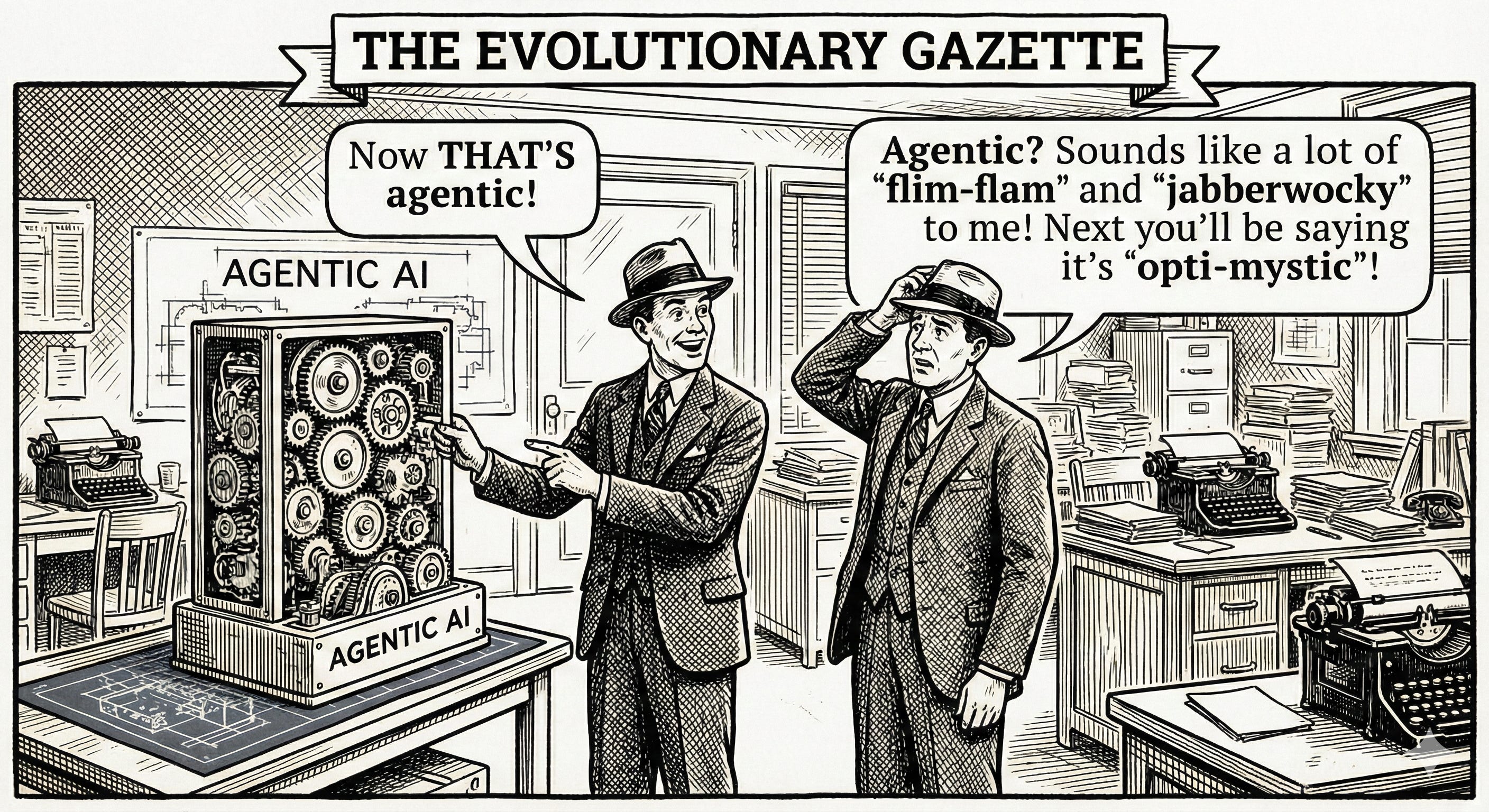
For the past several years, the nonprofit sector has talked about artificial intelligence almost entirely in the language of adoption - a word that quietly minimizes what may become humanity’s most consequential invention.
What's the best AI tool for my job?
Are we ready to even start?
Are our teams trained?
At face value, those questions sound reasonable. But, they also reveal a framing that has narrowed our imagination. Adoption assumes the system of work itself is stable, and that AI is simply a new tool to layer on top of it. A faster spreadsheet. A smarter chatbot. A more efficient way to do what we already do.
That framing was never inevitable. And for some of us, it was never the point.
When I began working seriously with AI in the nonprofit sector in 2018, the conversation was not about adoption. It was about evolution. It was about whether we could finally challenge some of the deepest structural limitations philanthropy has carried for centuries. Biases in who gets seen. Who gets asked. Who gets trusted. Who gets served. Long before algorithms, Aristotle wrote about the persistent challenges of charitable giving, and in many ways, the sector has been circling the same constraints for more than two thousand years.
What drew me to AI then was not its efficiency, but its potential to help us rethink the work itself from the ground up.
Looking back, the years leading up to the public arrival of ChatGPT now feel less like a breakthrough and more like a signal. They revealed that this technology could reshape how we analyze, decide, and connect, not just how we execute. They hinted at a future where intelligence could be applied more equitably, where insight was not reserved for the resourced few, and where the primary bottleneck to impact might finally shift away from human limitation and toward human intention.
Then ChatGPT arrived, and something subtle but important happened.
Over the past three years, our collective focus collapsed almost entirely into adoption. Training. Pilots. Policies. Guardrails. All necessary, but incomplete. In reducing AI to something to be adopted, we unintentionally minimized its gravity. We treated an evolutionary force as if it were just another tool.
In my role as Chief AI Officer at Virtuous, adoption is a given. There is no debate about whether teams should be using AI. The expectation is that every employee is leveraging these tools to perform their work more effectively. We moved past adoption quickly, not out of enthusiasm for technology, but out of respect for the work itself. When the mission matters, efficiency is not optional. Acceleration becomes a responsibility. The same is true for nonprofits and nonprofit professionals.
When presented with technology capable of fundamentally transforming how work gets done, the question is no longer whether we adopt it. The moral question becomes whether we are willing to accelerate our mission in proportion to what is now possible.
Limited technology once justified limited reach.
That excuse no longer holds.
And yet, acceleration alone is still not the destination.
Acceleration assumes the work itself remains intact, just faster. Agentic AI pushes us further. It asks whether the way work is structured, coordinated, and governed still makes sense at all.
Most nonprofit professionals have not heard the term. I know this because I ask. When I speak at conferences or facilitate leadership sessions, I pose the same simple question to nonprofit audiences: how many of you have heard the word “agentic” used to describe AI? A few hands go up. Having done this now in front of thousands of non-profit professionals, the result has never been more than five percent.
That gap matters. Not because nonprofits are behind, but because the world around them is already moving on. While much of the nonprofit sector is still debating adoption of generative AI, large parts of the private sector have shifted their attention almost entirely to agentic systems. They are no longer asking whether AI can assist work. They are focused on empowering systems to plan, coordinate, and execute work at scale.
Agentic AI is not a feature. It is not a trend. It is not a category of software to evaluate during your next budget cycle. It is a different model of how work itself gets done.
Agentic AI is a different operating model for work itself.
From adoption to evolution
To understand why agentic AI represents such a shift, we need to name a distinction that has been largely absent from nonprofit AI conversations.
Adoption is about tools.
Acceleration is about urgency.
Evolution is about systems.
Adoption asks how we integrate something new into existing workflows. Acceleration asks how we move faster because the work matters. Evolution asks which workflows no longer make sense at all.
For the past few years, most nonprofit AI use has been prompt-driven. A human asks. The system responds. The human refines the prompt. The system improves the output. This interaction model has shaped expectations. AI feels reactive. For many, generative AI has functioned as a glorified search engine - helpful, sometimes impressive, but ultimately dependent on constant human direction.
Agentic AI breaks that model.
At its simplest, agentic AI means you describe an outcome, not a sequence of steps. The system plans how to get there. It determines tasks, pulls relevant information, coordinates across data sources or tools, executes the work, and returns something coherent for review. Humans remain in the loop, but they stop micromanaging execution.
The shift sounds subtle. It is not.
Moving from prompting to delegating changes where human energy is spent. It moves people out of coordination and into judgment. Out of assembly and into accountability. Out of busywork and into meaning.
That is not adoption.
That is not even acceleration.
That is evolution.
The myth of the smarter chatbot
One reason this shift is easy to miss is that early agentic experiences still look familiar. New capabilities appear inside tools we already recognize. Agent modes. Workflow orchestration. Multi-step reasoning. It is tempting to see these as incremental improvements rather than a structural change.
That would be a mistake.
What we are witnessing is a redefinition of the relationship between humans and machines. When AI systems can hold context over time, plan multi-step work, and coordinate execution without constant instruction, they stop behaving like tools and start behaving like collaborators. Not collaborators with values or intent, but collaborators with stamina, memory, and execution capacity.
This is where fear often enters the conversation, so clarity matters.
Agentic AI is not about replacing leadership. It is not about letting algorithms run organizations. It is not about outsourcing responsibility. In fact, it demands the opposite.
When execution is delegated, responsibility becomes more visible. Someone still sets goals. Someone still defines constraints. Someone still decides what is acceptable, ethical, or aligned with mission. Agentic systems do not remove accountability. They expose it.
In a sector built on trust, that distinction is everything.
What this looks like in nonprofit work
The implications of agentic AI show up differently across roles, but the pattern is consistent.
For fundraisers, the shift is from effort to leverage, and eventually from reaction to anticipation. Instead of manually stitching together donor notes, emails, and CRM data, an agent can synthesize that information into clear next-step strategies and prioritization plans. Instead of drafting stewardship updates from scratch, it can assemble personalized communications grounded in real impact data, giving history, and program outcomes.
More importantly, agentic systems can begin to model outcomes before action is taken. They can simulate how different donors or segments might respond to various messages, asks, or timing strategies, allowing fundraisers to explore scenarios rather than guess at them. Instead of relying solely on instinct or retrospective reporting, teams can test approaches virtually, assess risk, and make more informed decisions about where to invest attention and care.
Even traditionally static work, like board reporting, shifts in nature. Instead of spending days assembling backward-looking summaries, agentic AI can generate narratives that integrate pipeline data, progress, risk, and projected outcomes into a single coherent briefing, helping leaders understand not just where they have been, but where they are likely headed.
For nonprofit leaders, the shift often begins as a reduction in friction, but it quickly becomes something more consequential. Financial folders and dashboards turn into board-ready briefings that do not just summarize the past, but surface risks, tradeoffs, and emerging patterns. Team updates are synthesized into strategic memos that highlight decisions required, scenarios worth exploring, and tensions that need attention, rather than overwhelming leaders with activity masquerading as progress.
Over time, agentic systems can help leaders move from retrospective oversight to prospective stewardship. They can model the downstream implications of strategic choices, simulate how different decisions might affect funding stability, program outcomes, or organizational capacity, and help leaders explore scenarios before those choices harden into reality. This does not eliminate uncertainty, but it dramatically lowers the cost of seeing around corners.
Even the most static elements of organizational life begin to change. Policies, onboarding materials, and internal documentation stop living in endless revision cycles and start behaving like living systems, updated intentionally as conditions shift. The result is not more control, but clearer governance, where leaders spend less time chasing information and more time exercising judgment in service of mission and trust.
For program teams, agentic AI shifts the work from reporting outcomes to continuously learning from them. Instead of manually aggregating surveys, case notes, and program metrics after the fact, agentic systems can synthesize participant feedback, qualitative observations, and outcomes data in near real time. Patterns that once took months to surface begin to emerge as programs are unfolding, not after they have concluded.
More importantly, agentic AI allows program teams to explore how interventions might perform under different conditions before changes are made. Teams can model variations in program design, delivery methods, or resource allocation, and simulate how those changes could affect participant experience and outcomes across different populations. This does not replace lived expertise or community voice, but it dramatically expands the organization’s ability to listen, test, and adapt responsibly.
Over time, this changes the posture of program work itself. Evaluation becomes less about proving impact after the fact and more about improving impact as it happens. Program design becomes iterative rather than episodic. And teams gain the capacity to respond to early signals of risk or opportunity before they harden into success or failure. The result is not more data, but deeper insight, allowing nonprofits to serve communities with greater humility, responsiveness, and care.
These are only a few examples, but they point to a larger shift. Agentic AI is less about speed and far more about posture - a willingness to rethink not just how we work, but what we assume about the work itself.
Why “operating system” is the right metaphor
Operating systems do not simply make tasks faster. They determine what kinds of work are possible at all.
When coordination costs drop, imagination becomes the bottleneck. Organizations are no longer constrained primarily by headcount or hours. They are constrained by how willing they are to question inherited processes.
This is where many nonprofit leaders will struggle, not because they lack values or intelligence, but because they have been conditioned to think in terms of adoption. Pilot the tool. Train the staff. Measure efficiency gains. Move cautiously.
Caution still matters. Responsibility still matters. But evolution requires something else alongside restraint: a willingness to admit that the way we’ve been doing things may not be the best or only way.
Agentic AI does not ask nonprofits to automate yesterday’s work more efficiently. It invites them to ask why that work exists in the first place.
It surfaces friction that was previously invisible because it was normalized. It exposes legacy processes that survive not because they are effective, but because they are familiar.
This can feel destabilizing. It should.
The real risk and the real opportunity
Used thoughtfully, agentic AI frees nonprofits from unnecessary friction. It collapses handoffs. It reduces busywork. It gives time back to the work that only humans can do: listening, deciding, building trust, and holding complexity with care.
Used poorly, it accelerates the wrong things. It amplifies broken processes. It reinforces shallow metrics. It creates the illusion of progress without the substance of it.
The difference is not technical. It is cultural.
Agentic AI will amplify whatever it touches, including poor fundraising practices and misaligned incentives, at unprecedented scale. That reality raises the bar for leadership. It requires clarity of mission, maturity of governance, and leaders willing to engage deeply with the systems they deploy rather than delegating them into a black box. Most of all, it demands a shift in posture, moving beyond the question of how to adopt AI toward a more consequential one: how work itself should change when the opportunity exists to reexamine, and in some cases retire, our once-coveted “best practices.”
That is why I believe agentic AI will be one of the defining nonprofit shifts of 2026. Not because it replaces people, but because it changes where people are most needed. It creates space for judgment in a world crowded out by execution. It restores attention to trust in a sector that cannot function without it.
Agentic AI is not about working faster. It is about working differently. It shifts nonprofits from managing tasks to stewarding outcomes, from coordinating effort to exercising judgment. In a sector built on trust, that distinction is everything. The organizations that thrive in the next chapter will not be the ones that adopted the most tools, but the ones that evolved how work actually happens.
This is not an AI decision.
It is a leadership one.
About the Author
Nathan Chappell, MBA, MNA, CFRE, AIGP is Chief AI Officer at Virtuous Software and co-author of Nonprofit AI and The Generosity Crisis. He writes about responsible innovation, the future of generosity, and the power of radical connection in the age of AI.