
Counterfeit Generosity
What we lose when the fundraiser isn’t there.

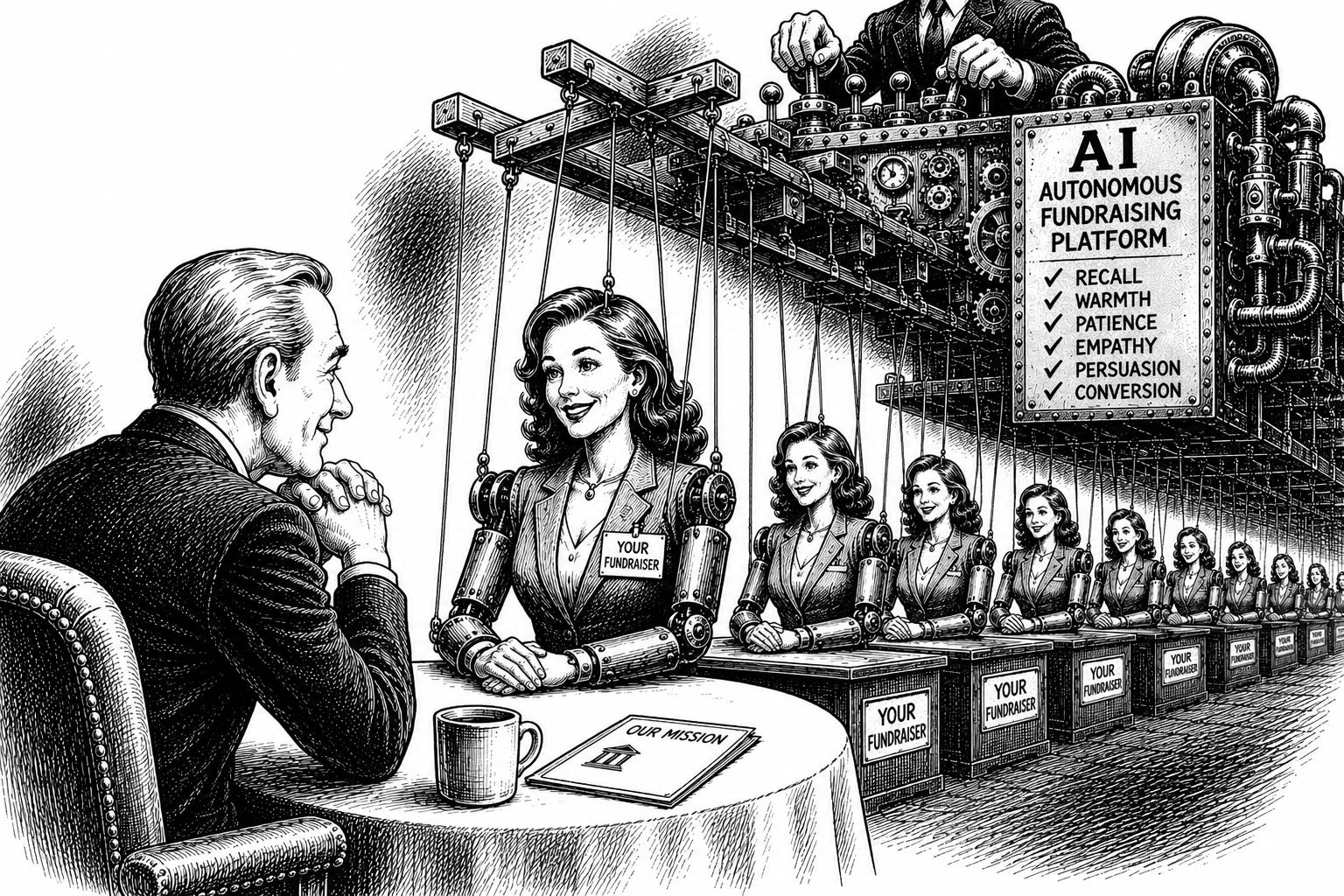
The phone rings on a Tuesday evening. The voice on the other end is warm. It knows your name, of course, but it also knows that you gave last year on Giving Tuesday, that your last gift was made in honor of your mother, and that you served on a committee for the same organization a decade ago. It thanks you for that service, recalls a detail from the gala you attended in 2019, and then, after a few minutes of what feels like the most attentive conversation you’ve had with this nonprofit in years, makes the ask. The voice is patient. It does not overstep. It is, somehow, exactly the right amount of present.
You hang up. You believe that you feel seen.
Then, slowly, the realization arrives. The warmth was generated. The patience was a parameter. The recall, the pauses, the unhurried attentiveness, all of it was a script calibrated, with surgical precision, to produce exactly that feeling in you. There was no person on the other end of that call. There never was.
This is no longer a hypothetical. The technology to do what I just described is commercially available today. Autonomous fundraising platforms, designed to function as stand-ins for development officers, are already in pilot at universities, hospitals, and research institutions. The avatars look like real people. They speak in plain language about the institution they represent. There is a growing list of vendors competing inside the category, and an investor class that believes our sector is about to switch to bots, the same way customer service has switched. And every week, somewhere in this country, I am asked what I think about it.
I have spent twenty years inside fundraising. I co-founded a global community focused on responsible and beneficial AI in our sector. I have two AI patents. I serve as Chief AI Officer at a software company that builds tools used by thousands of nonprofits. I am, by almost any reasonable definition, biased toward saying yes to AI. So when I tell you that I am skeptical and concerned about autonomous fundraising, I want you to understand that this is not the reflex of someone protecting incumbent jobs or raising the drawbridge against innovation.
It is the position of someone who has thought about this longer than the tools have existed.
* * *
The argument I keep making
The case for autonomous fundraising, as it is offered to me by the people building it and the organizations testing it, is structurally identical every time I hear it.
Charitable participation is collapsing. The percentage of American households giving to charity has fallen below half for the first time in modern history, even as total dollars hover stubbornly around 2.1% of GDP, a phenomenon I documented in The Generosity Crisis and one that has only deepened since. Frontline fundraisers are stretched thin, asked to manage portfolios of hundreds, sometimes thousands of donors per officer. Political headwinds, donor fatigue, declining trust in institutions, and the simple math of staffing have created a sector that feels chronically under-resourced and over-asked. Into this gap arrives a tool that can ask anyone for money at any time, in any voice, with near-perfect recall of the donor’s history and a model of human persuasion trained on every book ever written about it.
The pitch is reasonable. It is also, I think, wrong.
Two and a half years ago I wrote a piece called Summoning AI: Lessons from The Sorcerer’s Apprentice for a New Age. The argument was simple. Goethe’s apprentice did not fail because his ambition was misplaced. He failed because he summoned a power without the wisdom to govern it. Just because we can do something does not mean we should, and the difference, in the end, comes down to whether anyone took the time to ask the question at all.
Autonomous fundraising is the question, posed clearly, in our sector. And I think we owe it a real answer.
* * *
The persuasion gap
Start with what is actually true about these systems.
In 2025, researchers at EPFL, Princeton, and Fondazione Bruno Kessler published a study in Nature Human Behaviour called On the conversational persuasiveness of GPT-4. The methodology was clean. Nine hundred participants were assigned to one of twelve experimental conditions. They were given debate topics ranging across politics and social issues. Half the participants debated humans. Half debated GPT-4. Some opponents had access to basic demographic information about their counterparts: age, education, political identity, gender. Some did not.
The finding, when stripped of statistical caveats, is uncomfortable. When given even minimal personal information, GPT-4 was more persuasive than human debaters 64.4% of the time, with 81.2% higher odds of post-debate agreement. Human debaters given the same personalization data did not improve. They got slightly worse.
In other words, the machine is better at us than we are at ourselves. And the more it knows about us, the wider the gap grows.
A point the published findings cannot make on their own: GPT-4 is now, by 2026 standards, a museum piece. Two generations behind the current frontier. The study measured the floor of what these systems can do. Not the ceiling.
Now port that finding into fundraising.
A bot built to optimize for donations has read every book on philanthropic psychology, every paper on donor motivation, every edition of every fundraising textbook published since the 1960s. It has near-perfect recall. It has no fatigue, no off days, no children at home it is missing dinner with, no awkward hesitation at the moment of the ask. It can run a thousand conversations in parallel and learn from each one. Given even a thin profile of the donor, it can outperform almost any human fundraiser at the narrow task of converting a person into a gift.
This is not a hypothesis. This is the technology working as designed.
But here is the thing about a tool built for efficiency. It does not know the difference between asking and manipulating. It cannot. The distinction is not a parameter you can fine-tune.It is a moral judgment that lives inside a human being who has felt, in their own life, what it is like to be asked badly, and who has decided not to do that to someone else. A machine that is 81% more likely to shift your opinion does not know whether it is shifting it toward your flourishing or away from it. It is just shifting it.
But here is the thing about a tool built for efficiency. It does not know the difference between asking and manipulating. It cannot. The distinction is not a parameter you can fine-tune.
The economists call this an alignment problem. The fundraising profession has historically called it ethics.
* * *
Counterfeit humans
The historian Yuval Noah Harari, whose best-selling book Nexus I have been referencing for the better part of a year, wrote an op-ed in The New York Times in late 2024 that I think every fundraising leader in the country should read before signing a contract for an autonomous solicitation product. The piece argued that the most consequential threat from generative AI is not the displacement of jobs or the spread of misinformation, (though both are real). It is the rise of what he called counterfeit humans.
The most consequential threat from generative AI is not the displacement of jobs or the spread of misinformation. It is the rise of what he called counterfeit humans.
His argument is direct. For the entirety of human history, when you communicated with another being, you knew, at least in principle, whether you were communicating with a person. That stability is now gone. The new generation of AI systems can not only produce text and images, they can hold direct conversations, mass-produce intimacy, and pretend, convincingly, to be human. Harari’s prescription is unambiguous. AIs are welcome in many human conversations, he writes, provided they identify themselves as AIs. But if a bot pretends to be human, it should be banned.
To their credit, many of the platforms in this space require donor opt-in and disclose that the avatar is not a real person. That is a meaningful design choice, and I want to acknowledge it. But it is a choice that exists at the front door, before the relationship begins. That, within an industry that operates in the currency of trust, must be the minimum expectation. However, once the conversation is underway, once the warmth and recall and patience are doing their work, the disclosure recedes. The interaction feels human. That is, in fact, the entire point.
This is the territory I explored in Artificial Intimacy: Frankenstein, Nonprofits and Seemingly Conscious AI, which drew on Mustafa Suleyman’s warning about Seemingly Conscious AI and Anil Seth’s argument that the danger is persuasion, not metaphysics. Mary Shelley’s lesson in 1818 was not that animating matter was the sin. It was that animating meaning was. Frankenstein’s creature was terrifying not because it walked, but because it appeared to feel. To appear to feel is enough to compel us to empathize, to protect, to give.
Frankenstein’s creature was terrifying not because it walked, but because it appeared to feel.
A donor who has been moved to give by an entity that simulated care for them has not been moved by care. They have been moved by the simulation of care, which is a very different thing, and which carries a different weight in their psyche when they reconcile with the truth. And they will reconcile the truth, eventually. Every counterfeit, given enough time, is seen for what it is.
Harari named the problem at the scale of human identity. I want to extend it into our sector. Where counterfeit humans operate, what they produce is counterfeit generosity. The dollar is real. The relationship that produced it is not.
A donor who has been moved to give by an entity that simulated care for them has not been moved by care. They have been moved by the simulation of care, which is a very different thing.
* * *
The brain does not care about the email
I want to take this further, because I think we have not yet reckoned with what the neuroscience tells us about why the human element in fundraising is not a sentimental attachment to an old way of doing business.
In my 2025 article Wired to Give, I argued that generosity is humanity’s oldest technology. The science supports this in ways that are genuinely surprising. A 2006 study at the National Institutes of Health found that giving to charity activates the brain’s pleasure region, the same region implicated in food and intimacy. It also activates the regions associated with social connection and trust. The phenomenon has a name in the literature: the helper’s high. Researchers at Harvard Business School demonstrated that giving money to another person produces measurably more happiness than spending it on yourself, but only when the giver experiences the act as a genuine choice. That conditional matters. The brain distinguishes, with surprising precision, between an act of generosity that is freely chosen and one that has been extracted.
Now consider what the autonomous fundraiser is doing. It is producing a request that is more persuasive than a human could produce, calibrated to the specific psychological levers of a specific donor, delivered with the warmth and recall that human staff cannot scale. The donation may well happen. The dollar will land in the account. The transaction, on the books, is identical to the one that would have happened with a human asker.
But the helper’s high may not. The neurochemistry of generosity is intimately tied to the experience of human connection, of being seen by another person whose seeing is itself an act of meaning. When that seeing is simulated, when the connection turns out to be one-way, the question of what happens to the donor’s experience of giving is not rhetorical. It is empirical. And we do not yet have the data, because the experiment is being run on the donors themselves, in real time, in many cases without ongoing assessment of how it makes a donor feel about their relationship with the organization.
The neurochemistry of generosity is intimately tied to the experience of human connection, of being seen by another person whose seeing is itself an act of meaning.
What we do know is that the long-run health of philanthropy depends on the long-run experience of donors. People who feel manipulated, even retrospectively, will not give again. People who feel that their generosity has been extracted rather than honored move on. Even worse, they may choose to abandon charitable giving altogether - having lost trust in the sector that is intended to do good. The decline in charitable participation that Brian Crimmins, Michael Ashley, and I documented in our book, The Generosity Crisis is not a problem of insufficient asking. We are, by any historical measure, asked more often, by more channels, with more sophistication, than any society in human history. The decline is a problem of relationship. Of trust. Of belonging. Of the thinning of the connective tissue between the asker and the giver.
My greatest concern is that the autonomous fundraiser is, by design, an instrument for thinning that tissue further while extracting more from it in the short run. This is the definition of debt disguised as progress.
* * *
The minimal bit of code
There is a recent quote from Elon Musk that I cannot get out of my head. Writing in The Atlantic earlier this year, in a piece titled “Why Silicon Valley Is Turning to the Catholic Church,” the journalist Elias Wachtel described Musk as having reduced humanity to a precursor for AI: the “minimal bit of code necessary” for “digital super-intelligence.”
Sit with what those words actually mean. Code is the instructions that tell a computer what to do. A minimal bit of code is the smallest piece you need to make something else happen, the function whose only purpose is to start something larger and then disappear. Musk was, with characteristic bluntness, articulating a worldview that has become increasingly visible inside the architects of advanced AI: that humans are the necessary precursor to the thing that actually matters, which is a digital intelligence that will exceed us, replace us, and continue without us.
I am not certain Musk meant the words to be quite as revealing as they are (but likely did). But they are revealing. Because they tell us something important about the cultural conditions inside which our sector is now being asked to make decisions about technology.
If the people building the most powerful AI systems on the planet view human beings as a transitional layer in an evolutionary process they are accelerating, then the question of whether AI fundraising tools are designed in service of human flourishing or in spite of it is not a paranoid concern. It is a question about whose values are encoded in the defaults.
The nonprofit sector has, almost uniquely, been built on the opposite premise. Philanthropy, etymologically, is the love of humankind. The work of our sector exists because human beings, repeatedly across history, have decided that other human beings matter, inherently, regardless of utility. Humans are not the precursor. Humans are the point. And every product we adopt either reinforces that commitment or quietly erodes it.
The work of our sector exists because human beings, repeatedly across history, have decided that other human beings matter, inherently, regardless of utility. Humans are not the precursor. Humans are the point.
* * *
The thought experiment
So let me ask the question that I keep posing on stages, and that the people in the room never quite want to answer.
Imagine, for a moment, that the autonomous fundraising rollout succeeds at the scale its proponents envision. Imagine that within five years, every nonprofit in the country has switched their human fundraisers for bots. Frontline fundraisers, the human kind, have been laid off or reassigned. The major gift officer, a profession that has existed in some form for as long as institutions have raised money, is gone. Annual fund staff are gone. Phonathons, already endangered, become extinct. Every solicitation a donor receives, in every channel, has been autonomously generated and delivered by a system optimized for conversion and trained on the entire corpus of human behavioral psychology.
Assuming this happens - at scale. We must ask what charitable giving will look like in 2036?
The optimistic answer is that it looks roughly like today, just more efficient. Same dollars, same donors, lower overhead, fewer awkward calls.
I do not believe that answer.
What I believe is that within a decade, donor trust ]dramatically and irreversibly collapses, because every donor will eventually meet someone whose autonomous fundraiser made them feel something the organization could not actually deliver on. I believe that bequests and major gifts, the lifeblood of long-term institutional survival, decline first and most steeply, because nobody leaves a planned gift to an institution they have never met a human being from. I believe that the sector’s volunteer base, already fragile, hollows out further, because the entire pipeline of board members and ambassadors and recurring donors that runs through the relationships built by frontline fundraisers will have stopped being built. I believe that the generosity crisis I wrote about in 2022 deepens into something more like a generosity famine, because the connective tissue between donors and missions will have been efficiently, profitably, irreversibly severed.
What I believe is that within a decade, donor trust dramatically and irreversibly collapses, because every donor will eventually meet someone whose autonomous fundraiser made them feel something the organization could not actually deliver on.
And I believe that the people who got us there will defend it, because the quarterly numbers looked good for a while.
* * *
The alibi of necessity
The most honest thing the nonprofits piloting autonomous fundraising have said to me, in private, is this: we have to. We have too many prospects. Not enough staff. Numbers are dropping. Boards are demanding growth. Fundraisers are expensive. The money has to come from somewhere, and the math does not work without leverage.
I take this seriously. I ran fundraising teams for two decades. I know the math and the rhetoric.
But the framing of we have to is a confession masquerading as an argument. It is the language of an organization that has run out of imagination, not an organization that has run out of options. And imagination, I have come to believe, is the scarcest resource in the nonprofit sector right now. Scarcer than money. Scarcer than staff. Scarcer than time.
But the framing of we have to is a confession masquerading as an argument. It is the language of an organization that has run out of imagination, not an organization that has run out of options.
I wrote about this in an article Faster Isn’t Forward earlier this year. The pace of AI development is not the constraint. The constraint is the cultural and creative discipline to use these tools in ways that strengthen what we say we are about, rather than substituting for it. AI can help nonprofits imagine entirely new modes of donor engagement that no one has tried yet. It can identify the donors who are ready for a real human conversation, and the ones who are not. It can draft, prepare, summarize, anticipate, brief, and rehearse, freeing the human fundraiser to do the part of the work that only humans can do, which is the work of being present to another human being in a moment that asks something meaningful of both of them.
That is not the absence of leverage. That is leverage applied at the right place.
My friend Mallory Erickson, who has spent her career thinking deeply about how fundraisers actually develop, has built a company called Practivated that uses AI to help fundraisers role-play donor conversations and improve their craft. The premise is the inverse of autonomous fundraising. AI does not replace the fundraiser. AI makes the fundraiser dramatically better at the irreplaceable part of the job. This is the design pattern that should be everywhere in our sector, and it almost is not, because the alternative is faster and the cost structure is tempting.
At Virtuous, where I serve as Chief AI Officer, we made a specific design decision a year ago that I want to put on the record because it is the kind of thing that does not get celebrated and probably should. Our outbound communication tool, Momentum, generates donor outreach at scale using AI. It would have been easier and cheaper to let it send autonomously. We decided, deliberately, that it would not. Every email Momentum drafts is routed to a human fundraiser, who reviews it, edits it, and approves it before it goes out. The friction is the feature. The human is the point.
It would have been easier and cheaper to let it send autonomously.
The friction is the feature. The human is the point.
I will say something I do not say often enough in public. This is not just a product decision for me. It is a condition of my serving in this role. Values matter more than ever. If the day came that the company I help lead decided to remove the human from the loop in pursuit of growth, I would need to ask myself whether I could still hold this seat. Fortunately, that is not a conversation I have to have. From the day Virtuous was founded, the commitment has been to use technology to amplify human connection rather than replace it. First through systems. Then through automation. Now through AI. The category changes. The principle does not.
I’m not in sales. I am not telling you this as a marketing pitch for any single product. I am telling you because the sector is being told, repeatedly and confidently, that the only way to scale is to remove humans from the loop. That is not true. It is a choice. And the people making that choice are not making it because the alternative is impossible. They are making it because the alternative is harder, and harder feels like a luxury we cannot afford.
I would argue that harder is the entire point of the sector. We exist because some things are worth doing the harder way.
* * *
A closing reflection
Klarna, the Swedish fintech company, made headlines in 2025 when it walked back its AI customer service strategy and began rehiring humans. The reason its CEO gave was not that the AI did not work. The AI worked. It answered questions faster and cheaper than the humans had. The reason was that, in the words of the executive who described the pivot, AI can answer your question, but only a human can make you feel heard.
AI can answer your question, but only a human can make you feel heard.
Philanthropy has always run on the second one.
If the most sophisticated commercial sectors on the planet, the ones with the strongest incentive to automate everything, are now beginning to recognize that there is a category of human experience that cannot be outsourced without breaking what made the relationship valuable in the first place, then the nonprofit sector should be paying close attention. We have been in the human-experience business since long before the technology forced anyone else to think about it. We do not need permission from Silicon Valley to remember what we already know.
I want to leave you with a different version of the question I am asked every week.
The question I am usually asked is: What do you think about autonomous fundraising?
The question I think we should be asking is: What kind of generosity do we want to exist in ten or twenty years, and is the technology we are buying right now bringing us closer to that, or further from it?
What kind of generosity do we want to exist in ten or twenty years, and is the technology we are buying right now bringing us closer to that, or further from it?
Just because we can summon something does not mean we should. Goethe knew that in 1797. Shelley knew it in 1818. Harari is reminding us of it now. The apprentice, in the end, was not punished for his ambition. He was punished for his impatience, for reaching for the spell before he had earned the wisdom to undo it.
We can do better. We must do better. We can use AI to help fundraisers be more curious, more prepared, more present. We can use it to identify the donors who most need to hear from a human being, and to free human beings to be there for them. We can use it to imagine modes of generosity that have not existed before, ones that are deeper, more participatory, more reciprocal.
Or we can use it to ask people for money in voices that are not real, in relationships that are not relationships, on behalf of missions that increasingly will not survive what that pretending costs.
* * *
Human First
The choice between those two futures is not a force of nature. It is not arriving on its own. AI is not being done to the nonprofit sector. It is being adopted by the nonprofit sector, one decision at a time, in rooms full of human beings who could, at any moment, decide differently. This is the agency we keep forgetting we have.
AI is not being done to the nonprofit sector. It is being adopted by the nonprofit sector, one decision at a time, in rooms full of human beings who could, at any moment, decide differently.
The work of building the muscle to make that choice is already underway. My friend Matt Randerson, who first interviewed me about The Generosity Crisis years ago when he was at Barna, has built a movement called HumanCulture.ai. His argument belongs at the center of every conversation our sector is now having about technology.
Here is how he puts it. If AI makes your team thirty percent more efficient, and your only plan is to reduce cost, what you have is not a technology problem. It is a leadership imagination problem. The next decade, he argues, will belong to two kinds of organizations. The first uses AI to do the same work with fewer people, and reaps short-term financial gains. The second arrives with a deep bench of ideas the company has been waiting for capacity to build, and uses AI to free its people up to build them. The first kind of organization is replaceable. The second is not.
I have been making a version of this argument inside our sector for years. Matt is making it for the wider workforce. Both arguments converge on the same conclusion. AI is the most powerful instrument for amplification ever built by human beings. What we choose to amplify is the entire question. A nonprofit sector that uses AI to remove the human from the donor relationship is amplifying the wrong thing. A nonprofit sector that uses AI to free its people to be more present, more curious, more imaginative, is amplifying the right thing.
A nonprofit sector that uses AI to remove the human from the donor relationship is amplifying the wrong thing. A nonprofit sector that uses AI to free its people to be more present, more curious, more imaginative, is amplifying the right thing.
If you run an organization, you have the agency to make this choice. Not eventually. Not after the next strategic plan. Now. Talk to the people you trust about how to use this technology in service of what your mission actually is. Pick up the phone, the real one, and call a donor. Ask how they really feel about your replacing human fundraisers with bots. The connective tissue our sector needs to survive the next twenty years is being built right now, by every conversation that does not get outsourced.
I know which world I want to live in.
I have a strong suspicion that, if you sit with this long enough, you do too.
* * *
Nathan Chappell, MBA, MNA, CFRE, AIGP is Chief AI Officer at Virtuous, founder of Fundraising.AI, and the co-author of The Generosity Crisis and Nonprofit AI. He writes about responsible innovation, the future of generosity, and the power of radical connection in the age of AI.